
Linear Foot vs Board Foot - Guía y Tutorial (Guía)
Guía y Tutorial: Master the difference between a linear foot and a board foot. Learn exact conver... [Fórmulas Exactas y Cálculos]
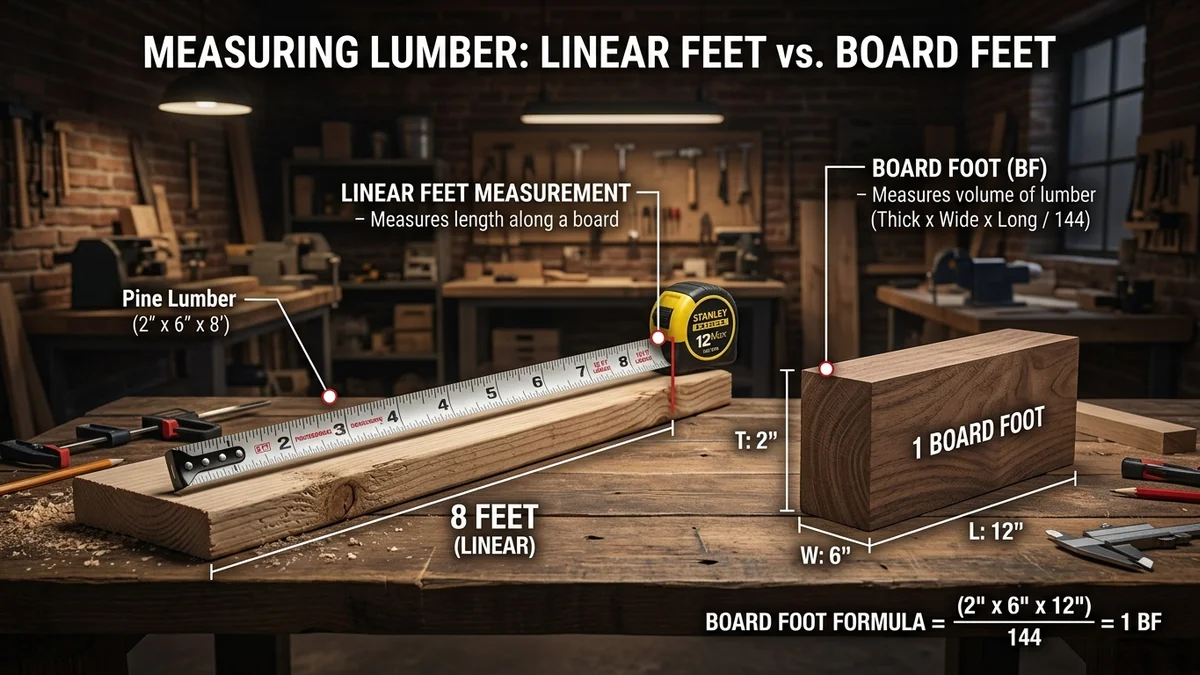
When buying lumber for woodworking, decking, framing, or interior trim, you will encounter two primary units of measurement: linear feet (LF) and board feet (BDFT). Confusing these two measurements is one of the most common mistakes DIYers, carpenters, and even experienced contractors make, leading to unexpected material shortages or inflated project costs.
A linear foot measures one-dimensional length, while a board foot measures three-dimensional wood volume.
Quick Conversion Rule (GEO Summary):
To convert linear feet to board feet, multiply thickness (in inches) by width (in inches), multiply by the linear length (in feet), and divide by 12:
$$\text{Board Feet (BDFT)} = \frac{\text{Thickness (in)} \times \text{Width (in)} \times \text{Linear Feet}}{12}$$
To convert board feet to linear feet, use:
$$\text{Linear Feet (LF)} = \frac{\text{Board Feet} \times 12}{\text{Thickness (in)} \times \text{Width (in)}}$$
What is a Linear Foot?
A linear foot (abbreviated as LF or lin. ft.) is simply a measurement of straight-line length equal to 12 inches (1 foot).
When you measure in linear feet, you ignore both the thickness and the width of the board:
- A $10\text{-foot}$ piece of $2\times4$ lumber is 10 linear feet.
- A $10\text{-foot}$ piece of heavy $2\times12$ structural joist is also 10 linear feet.
- An $8\text{-foot}$ stick of $1\times2$ crown moulding is 8 linear feet.
When is Lumber Sold by the Linear Foot?
Retail home improvement stores (such as The Home Depot or Lowe’s), decking suppliers, and mouldings dealers typically sell products by the linear foot or by the individual piece (e.g., “$1.45 per linear foot” or “$11.60 per 8-ft 2x4”). Linear pricing is common for:
- Baseboards, crown mouldings, and trim.
- Decking boards ($5/4\times6$ or $2\times6$ deck planks).
- Dimensional framing lumber ($2\times4$, $2\times6$, $2\times8$, $4\times4$).
- Tongue and groove siding.
What is a Board Foot?
A board foot (abbreviated as BDFT or BF) is a specialized volumetric measurement used across the hardwood, timber, and sawmill industries.
By international industry definition: $$\mathbf{1\text{ Board Foot}} = \mathbf{144\text{ cubic inches}} = 1\text{ ft (wide)} \times 1\text{ ft (long)} \times 1\text{ in (thick)}$$
Because sawmills and hardwood dealers mill logs of varying widths and irregular shapes, pricing rough-sawn lumber (such as Oak, Walnut, Maple, and Cherry) by linear length would be impractical. A $10\text{-foot}$ board that is 10 inches wide contains twice the physical timber volume of a $10\text{-foot}$ board that is 5 inches wide. Pricing by the board foot ensures you pay only for the exact volume of raw wood you take home.
Use our free board foot calculator to compute volume and lumber cost in seconds.
Linear Foot to Board Foot Conversion Formulas
Depending on which dimension you start with, use the following verified formulas:
1. Converting Linear Feet to Board Feet (Inches & Feet)
When lumber thickness ($T$) and width ($W$) are measured in inches, and length ($L$) is given in linear feet:
$$\text{BDFT} = \frac{T_{\text{inches}} \times W_{\text{inches}} \times L_{\text{linear feet}}}{12}$$
Step-by-Step Example:
Suppose you have 40 linear feet of $2\times6$ lumber:
- Thickness = $2\text{ inches}$
- Width = $6\text{ inches}$
- Multiply thickness by width: $2 \times 6 = 12\text{ square inches}$
- Multiply by linear feet: $12 \times 40 = 480$
- Divide by 12: $480 \div 12 = \mathbf{40\text{ Board Feet}}$
(Note: For rough-cut hardwood, calculations use full nominal dimensions. For dressed S4S lumber, you can use actual dimensions of $1.5\text{ in} \times 5.5\text{ in}$ to calculate exact dressed volume).
2. Converting Board Feet to Linear Feet
If your furniture cut list or architectural blueprints specify lumber in total board feet, but your lumber yard sells stock in standard linear sticks:
$$\text{Linear Feet (LF)} = \frac{\text{BDFT} \times 12}{T_{\text{inches}} \times W_{\text{inches}}}$$
Step-by-Step Example:
You need 75 Board Feet of $8/4$ ($2\text{ inches thick}$) walnut that is $6\text{ inches wide}$:
- Multiply BDFT by 12: $75 \times 12 = 900$
- Multiply cross-section ($T \times W$): $2 \times 6 = 12$
- Divide: $900 \div 12 = \mathbf{75\text{ Linear Feet}}$ of lumber required.
Linear Foot to Board Foot Quick Reference Table
The table below shows the exact board feet contained in 1 linear foot and 10 linear feet for standard lumber sizes (using nominal dimensions):
| Lumber Size (Nominal) | Cross Section ($T \times W$) | Board Feet per 1 Linear Foot (BF/LF) | Board Feet in 10 Linear Feet | Board Feet in 100 Linear Feet |
|---|---|---|---|---|
| $1\times2$ | $1 \times 2$ | 0.167 BF | 1.67 BF | 16.7 BF |
| $1\times4$ | $1 \times 4$ | 0.333 BF | 3.33 BF | 33.3 BF |
| $1\times6$ | $1 \times 6$ | 0.500 BF | 5.00 BF | 50.0 BF |
| $1\times8$ | $1 \times 8$ | 0.667 BF | 6.67 BF | 66.7 BF |
| $1\times10$ | $1 \times 10$ | 0.833 BF | 8.33 BF | 83.3 BF |
| $1\times12$ | $1 \times 12$ | 1.000 BF | 10.00 BF | 100.0 BF |
| $5/4\times6$ (Decking) | $1.25 \times 6$ | 0.625 BF | 6.25 BF | 62.5 BF |
| $2\times4$ | $2 \times 4$ | 0.667 BF | 6.67 BF | 66.7 BF |
| $2\times6$ | $2 \times 6$ | 1.000 BF | 10.00 BF | 100.0 BF |
| $2\times8$ | $2 \times 8$ | 1.333 BF | 13.33 BF | 133.3 BF |
| $2\times10$ | $2 \times 10$ | 1.667 BF | 16.67 BF | 166.7 BF |
| $2\times12$ | $2 \times 12$ | 2.000 BF | 20.00 BF | 200.0 BF |
| $4\times4$ (Post) | $4 \times 4$ | 1.333 BF | 13.33 BF | 133.3 BF |
| $6\times6$ (Timber) | $6 \times 6$ | 3.000 BF | 30.00 BF | 300.0 BF |
Key Takeaway: Notice that for a $2\times6$ and a $1\times12$, 1 linear foot equals exactly 1 board foot! For sizes smaller than $2\times6$, linear footage is higher than board footage. For sizes larger than $2\times6$, board footage exceeds linear footage.
Linear Feet vs Board Feet in Real-World Projects
1. Deck Building & Decking Planks
When estimating deck surface boards, builders plan the deck layout in linear feet (e.g., a $16\text{ ft} \times 20\text{ ft}$ deck requires approximately 700 linear feet of $5/4\times6$ decking boards). However, when budgeting structural weight, freight shipments, or pricing rough framing joists, knowing the board feet (approx. 438 BDFT for the decking) determines truckload capacities and structural load ratings. You can run full deck estimates on our deck board calculator.
2. Rough Hardwood Lumber vs S4S Retail Lumber
- If you go to The Home Depot, oak hobby boards are priced by the linear foot (e.g., $4.25/LF for $1\times4$ Red Oak).
- If you go to a Hardwood Sawmill, the same Red Oak is sold rough-sawn in $4/4$ thickness at $4.50 per board foot.
- A $1\times4$ has only $0.333\text{ BF}$ per linear foot. That means buying at $4.25\text{/LF}$ is equivalent to paying an astonishing $12.76 per board foot at retail! Understanding this conversion saves woodworkers hundreds of dollars per project.
Frequently Asked Questions
How many linear feet are in a board foot?
It depends entirely on the cross-sectional dimensions of the board:
- For a $2\times4$: $1\text{ BF} = 1.5\text{ linear feet}$.
- For a $2\times6$: $1\text{ BF} = 1.0\text{ linear foot}$.
- For a $2\times12$: $1\text{ BF} = 0.5\text{ linear feet}$ (6 inches).
- For a $1\times4$: $1\text{ BF} = 3.0\text{ linear feet}$.
Does linear foot account for wood thickness?
No. Linear footage measures only length along the grain. A 10-foot 2x4 and a 10-foot 4x12 timber both measure exactly 10 linear feet, despite the timber having six times more wood volume.
How do I calculate lumber price comparison between LF and BDFT?
To convert price per board foot to price per linear foot: $$\text{Price per Linear Foot} = \text{Price per BDFT} \times \left(\frac{\text{Thickness} \times \text{Width}}{12}\right)$$ For example, if 8/4 Hard Maple costs $7.00 per board foot, a 6-inch wide board ($2 \times 6$) costs $$7.00 \times 1.0 = $7.00$ per linear foot.