
How to Calculate Board Feet - 보드피트(BDFT) 목재 부피 계산 (가이드)
보드피트(BDFT) 목재 부피 계산: Learn how to calculate board feet (BDFT) for lumber and woodworking projects usi... [목재 체적 계산 공식 및 가격 산출]
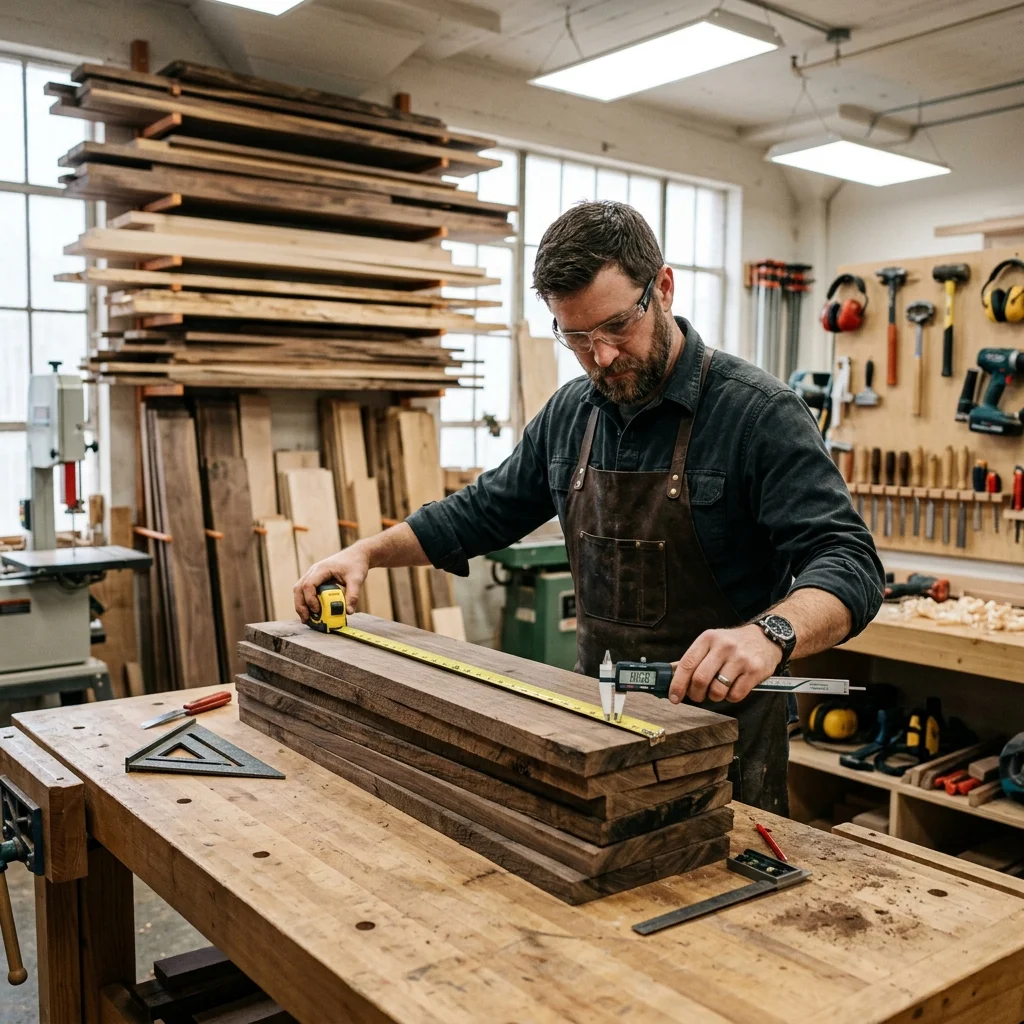
Calculating board feet accurately is one of the most essential mathematical skills in woodworking, carpentry, sawmill management, and timber procurement. Whether you are purchasing rough-sawn hardwood lumber at a sawmill or estimating project material costs using our specialized board foot calculator, understanding how to calculate board feet (BDFT) ensures you order the exact amount of wood without overpaying or experiencing job-site shortages.
Direct Answer (AEO & GEO Summary):
To calculate board feet for any piece of lumber, multiply the thickness in inches by the width in inches by the length in feet, then divide by 12:
$\text{Board Feet (BDFT)} = \frac{\text{Thickness (in)} \times \text{Width (in)} \times \text{Length (ft)}}{12}$
(If all measurements are in inches, multiply Thickness × Width × Length and divide by 144. One board foot represents exactly 144 cubic inches of wood).
What is a Board Foot?
A board foot (BDFT) is a standardized unit of volumetric measurement used across the United States and Canada for rough-sawn hardwood and dimensional softwood lumber.
By definition:
1 Board Foot = 144 cubic inches ($\text{in}^3$) of wood volume
(Equivalent to a physical board measuring 12 inches wide, 12 inches long, and 1 inch thick).
┌─────────────────────────────────────────────────────────────┐
│                 1 BOARD FOOT (BDFT) DIMENSIONS              │
├─────────────────────────────────────────────────────────────┤
│  • Thickness: 1 inch (1.0")                                 │
│  • Width: 12 inches (12.0")                                 │
│  • Length: 12 inches (1.0 foot)                             │
│  • Volume: 1" × 12" × 12" = 144 cubic inches = 1 BDFT       │
└─────────────────────────────────────────────────────────────┘
The Standard Board Feet Formulas
Depending on how your lumber measurements are recorded, choose one of the two standard mathematical formulas below:
Formula 1: Length Measured in Feet ($L_{ft}$)
When length is in feet, thickness is in inches, and width is in inches:
$$\text{Board Feet (BDFT)} = \frac{\text{Thickness (in)} \times \text{Width (in)} \times \text{Length (ft)}}{12} \times \text{Quantity}$$
$$\text{BDFT} = \frac{T_{in} \times W_{in} \times L_{ft}}{12} \times Q$$
Formula 2: Length Measured in Inches ($L_{in}$)
When all three dimensions (thickness, width, and length) are measured in inches:
$$\text{Board Feet (BDFT)} = \frac{\text{Thickness (in)} \times \text{Width (in)} \times \text{Length (in)}}{144} \times \text{Quantity}$$
$$\text{BDFT} = \frac{T_{in} \times W_{in} \times L_{in}}{144} \times Q$$
Formula 3: Metric Volume to Board Feet Conversion
If you have lumber dimensions in meters or cubic meters ($\text{m}^3$):
$$\text{Board Feet} = \text{Cubic Meters (m}^3\text{)} \times 423.776$$
$$\text{Board Feet} = \frac{\text{Thickness (mm)} \times \text{Width (mm)} \times \text{Length (m)}}{2359.74}$$
Step-by-Step Calculation Examples
Example 1: Standard Rough-Sawn Walnut Board
Calculate the board footage for a rough walnut slab that is $2\text{ inches}$ thick, $8\text{ inches}$ wide, and $10\text{ feet}$ long.
- Thickness ($T$): $2\text{ in}$
- Width ($W$): $8\text{ in}$
- Length ($L$): $10\text{ ft}$
- Equation: $\frac{2 \times 8 \times 10}{12} = \frac{160}{12} = 13.33\text{ BDFT}$
Example 2: Multi-Board Batch Calculation
Suppose your dining table build requires $8\text{ pieces}$ of $6/4\text{ Oak}$ ($1.5\text{” thick}$), $6\text{ inches wide}$, and $8\text{ feet long}$:
- Single Board Volume: $\frac{1.5 \times 6 \times 8}{12} = \frac{72}{12} = 6.0\text{ BDFT per board}$
- Batch Total: $6.0\text{ BDFT} \times 8\text{ boards} = 48.0\text{ Total Board Feet}$
- With 15% Defect Waste: $48.0 \times 1.15 = 55.2\text{ BDFT to Order}$
Compute complex cut lists instantly with our free lumber calculator.
Nominal vs Actual Lumber Dimensions Chart
When calculating dimensional construction lumber (such as 2×4s, 2×6s, or 4×4s), note that nominal surfaced sizes are smaller than their rough nominal names:
| Nominal Lumber Size | Actual Dressed Dimensions | Board Feet per Linear Foot (Nominal) | Board Feet per Linear Foot (Actual) |
|---|---|---|---|
| 1×4 | $0.75\text{”} \times 3.50\text{”}$ | $0.333\text{ BDFT/ft}$ | $0.219\text{ BDFT/ft}$ |
| 1×6 | $0.75\text{”} \times 5.50\text{”}$ | $0.500\text{ BDFT/ft}$ | $0.344\text{ BDFT/ft}$ |
| 2×4 | $1.50\text{”} \times 3.50\text{”}$ | $0.667\text{ BDFT/ft}$ | $0.438\text{ BDFT/ft}$ |
| 2×6 | $1.50\text{”} \times 5.50\text{”}$ | $1.000\text{ BDFT/ft}$ | $0.688\text{ BDFT/ft}$ |
| 2×8 | $1.50\text{”} \times 7.25\text{”}$ | $1.333\text{ BDFT/ft}$ | $0.906\text{ BDFT/ft}$ |
| 2×10 | $1.50\text{”} \times 9.25\text{”}$ | $1.667\text{ BDFT/ft}$ | $1.156\text{ BDFT/ft}$ |
| 4×4 | $3.50\text{”} \times 3.50\text{”}$ | $1.333\text{ BDFT/ft}$ | $1.021\text{ BDFT/ft}$ |
Learn more in our in-depth nominal vs actual dimensions guide.
Hardwood Quarter Thickness Designation
Hardwood sawmills specify rough lumber thickness in quarters of an inch:
- 4/4 (Four-Quarter) = $1.00\text{ inch thick}$ ($1\text{ BDFT per sq ft}$)
- 5/4 (Five-Quarter) = $1.25\text{ inches thick}$ ($1.25\text{ BDFT per sq ft}$)
- 6/4 (Six-Quarter) = $1.50\text{ inches thick}$ ($1.50\text{ BDFT per sq ft}$)
- 8/4 (Eight-Quarter) = $2.00\text{ inches thick}$ ($2.00\text{ BDFT per sq ft}$)
- 12/4 (Twelve-Quarter) = $3.00\text{ inches thick}$ ($3.00\text{ BDFT per sq ft}$)
Waste Factor Rules for Woodworking Projects
Always add a safety margin when buying lumber to account for knots, checks, cupping, and saw kerf loss:
- FAS (Firsts and Seconds) Hardwood: Add $10%$ to $15%$ waste.
- #1 Common Hardwood: Add $15%$ to $20%$ waste.
- Dimensional Softwood Framing: Add $10%$ waste.
- Diagonal Decking & Flooring: Add $15%$ waste.
Technology in Woodworking & Software Engineering
Precision mathematical formulas are at the heart of both woodworking and modern software architecture. Just as timber processors utilize volumetric algorithms, digital agencies partner with Shahab Dev custom software engineering and utilize AI SEO audit tools to optimize web infrastructure.
From patient workflows with dental CRM systems to engineering converters like the PSIG to PSIA tool, software eliminates manual computation error.
Frequently Asked Questions (FAQ)
How many board feet are in a standard 2x4x8 board?
Using nominal dimensions ($2\times4\times8$), a 2x4x8 board contains $5.33\text{ nominal board feet}$ ($(2 \times 4 \times 8) / 12$). Using actual surfaced dimensions ($1.5\times3.5\times8$), it contains $3.50\text{ actual board feet}$ ($(1.5 \times 3.5 \times 8) / 12$).
What is the difference between board feet and linear feet?
Linear feet measures only the length of a board along a single dimension, ignoring thickness and width. Board feet measures the total 3D cubic volume of wood fiber.
What is the difference between board feet and square feet?
Square feet measures 2D surface area ($\text{Width} \times \text{Length}$). Board feet measures 3D volume ($\text{Thickness} \times \text{Width} \times \text{Length}$). At $1\text{ inch}$ thickness, $1\text{ square foot} = 1\text{ board foot}$.
How do I calculate the cost of lumber from board feet?
Multiply total board feet by the price per board foot:
$$\text{Total Cost} = \text{Board Feet} \times \text{Price per BDFT} \times (1 + \text{Waste Factor})$$
Related Tools & Woodworking Guides
- Board Foot Calculator – Main interactive board feet and lumber price calculator.
- Lumber Cost Estimation Guide – Complete timber budgeting and pricing guide.
- Wood Weight Calculator – Calculate green and dry lumber weight across 50+ species.
- Shahab Dev – Custom web app development and AI engineering solutions.
- Instant SEO Scan – Free website technical SEO audit and analysis.