
10 Essential Woodworking Math Formulas Every Carpenter Should Know - Cálculo de Board Feet (Pés de Prancha) (Guia)
Cálculo de Board Feet (Pés de Prancha): Master essential woodworking math formulas: quick board feet mental shortcuts, m... [Fórmulas de Volume de Madeira e Preços]
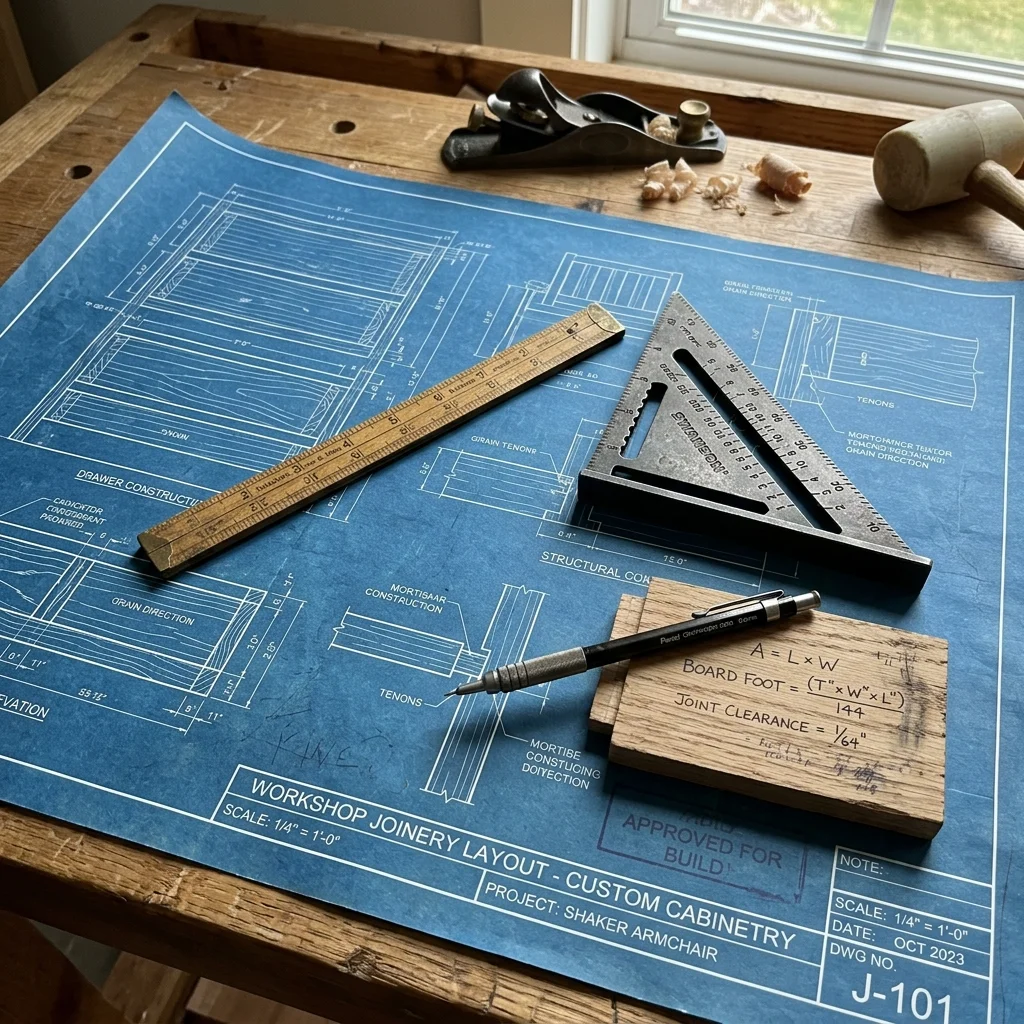
Woodworking and fine carpentry are equal parts artistry and mathematics. Whether calculating lumber volume on an interactive wood calculator, cutting precision compound miters, or scaling furniture proportions, having key mathematical formulas at your fingertips prevents costly mistakes.
Short answer: the formula you will use most is Board Feet = (Thickness in inches x Width in inches x Length in feet) / 12. For example, a 2x8 board that is 12 feet long gives (1.5 x 7.25 x 12) / 12 = 10.875 board feet using actual dressed sizes.
Here are the top 10 woodworking math formulas every carpenter, cabinetmaker, and woodworker should master.
1. Quick Board Feet Mental Shortcut
When working with standard 1-inch (4/4) thick lumber:
$$\text{Board Feet} = \frac{\text{Width (in)} \times \text{Length (ft)}}{12}$$
Mental Rule: A 1-inch board that is 6 inches wide and 10 feet long has $(6 \times 10) / 12 = 5 \text{ BDFT}$.
2. Linear Feet to Board Feet Conversion
$$\text{Board Feet} = \text{Linear Feet} \times \left(\frac{T_{in} \times W_{in}}{12}\right)$$
3. The 3-4-5 Right Triangle Rule (Square Check)
To verify if a workbench frame or deck corner is perfectly square ($90^\circ$ angle):
- Measure 3 feet along one edge.
- Measure 4 feet along the adjacent edge.
- The diagonal distance between points must equal 5 feet ($3^2 + 4^2 = 5^2$).
4. Miter Angle Formula for Multi-Sided Polygons
To cut miter joints for an $N$-sided frame (e.g., octagon or hexagon):
$$\text{Miter Angle} = \frac{360^\circ}{2 \times N} = \frac{180^\circ}{N}$$
- Hexagon (6 sides): $180 / 6 = 30^\circ$ miter cut.
- Octagon (8 sides): $180 / 8 = 22.5^\circ$ miter cut.
5. Golden Ratio Proportions (1 : 1.618)
For visually pleasing tabletop and cabinet proportions:
$$\text{Ideal Length} = \text{Width} \times 1.618$$
6. Waste Factor Formula
$$\text{Lumber to Purchase} = \text{Project Net BDFT} \times (1 + \text{Waste Factor percentage})$$
7. Square Feet to Board Feet for Sheet Goods
$$\text{BDFT} = \text{Area (sq ft)} \times \text{Thickness (in)}$$
8. Wood Moisture Content Percentage (%MC)
$$%MC = \left(\frac{\text{Original Green Weight} - \text{Oven Dry Weight}}{\text{Oven Dry Weight}}\right) \times 100$$
9. Cubic Feet to Board Feet Conversion
$$1 \text{ Cubic Foot} = 12 \text{ Board Feet}$$
$$\text{Board Feet} = \text{Cubic Feet} \times 12$$
10. Metric Cubic Meters to Board Feet
$$1 \text{ m}^3 = 423.776 \text{ Board Feet}$$
$$\text{Board Feet} = \text{Cubic Meters (m}^3\text{)} \times 423.776$$
Worked Example: One Board, Three Formulas
Take one board at actual dressed size 1.5 inches thick, 7.25 inches wide, and 12 feet long, which is a 2x8 board.
- Board feet (formula 1): (1.5 x 7.25 x 12) / 12 = 10.875 board feet.
- Linear feet to board feet (formula 2): 12 linear feet x (1.5 x 7.25 / 12) = 12 x 0.90625 = 10.875 board feet, which matches step 1.
- Cubic feet to board feet (formula 9): cubic feet for this board = 10.875 / 12 = 0.90625 cubic feet, and 0.90625 x 12 = 10.875 board feet, which matches again.
The same board gives the same answer through all three routes, so if your three answers disagree, check whether you mixed nominal and actual sizes, or inches and feet, before you order.
Summary Reference Table
| Formula Name | Equation / Ratio | Practical Application |
|---|---|---|
| Board Feet | $(T” \times W” \times L’) / 12$ | Hardwood ordering & material pricing |
| 3-4-5 Square | $a^2 + b^2 = c^2$ | Squaring walls, decks, and frames |
| Polygon Miter | $180^\circ / N$ | Segmented woodturning & picture frames |
| Golden Ratio | 1 : 1.618 | Furniture & cabinet design aesthetics |
| Cu Ft to BDFT | $\text{Cu Ft} \times 12$ | Heavy timber & beam log scaling |
Frequently Asked Questions
Which woodworking math formula do I need most often?
The board feet formula: Board Feet = (Thickness in inches x Width in inches x Length in feet) / 12. It prices hardwood, sizes orders, and checks a lumber yard invoice. The 3-4-5 rule for square corners and the waste factor formula are the next two you will use on nearly every job.
Should I use nominal or actual lumber sizes in the formulas?
Use actual dressed sizes for true wood volume, because a 2x4 is really 1.5 x 3.5 inches. Use nominal sizes only when the lumber yard bills by nominal size, as softwood framing usually is. Mixing the two is the most common source of wrong board foot totals. Our nominal vs actual dimensions guide shows every standard size side by side.
How much extra lumber should I buy for waste?
Add 15 to 20 percent for standard rectangular stock, and 25 to 30 percent for wild-grained, knotted, or live-edge lumber. For a full project estimate, see our guides on how many board feet are in a standing tree and how many board feet you need for a shed.
Related Resources
- Main Board Foot Calculator – Calculate board feet, lumber volume, and material cost.
- How Many Board Feet in a Standing Tree – Estimate lumber yield from a living tree before you cut.
- How Many Board Feet for a Shed – Full shed lumber estimate with framing, siding, and roofing.